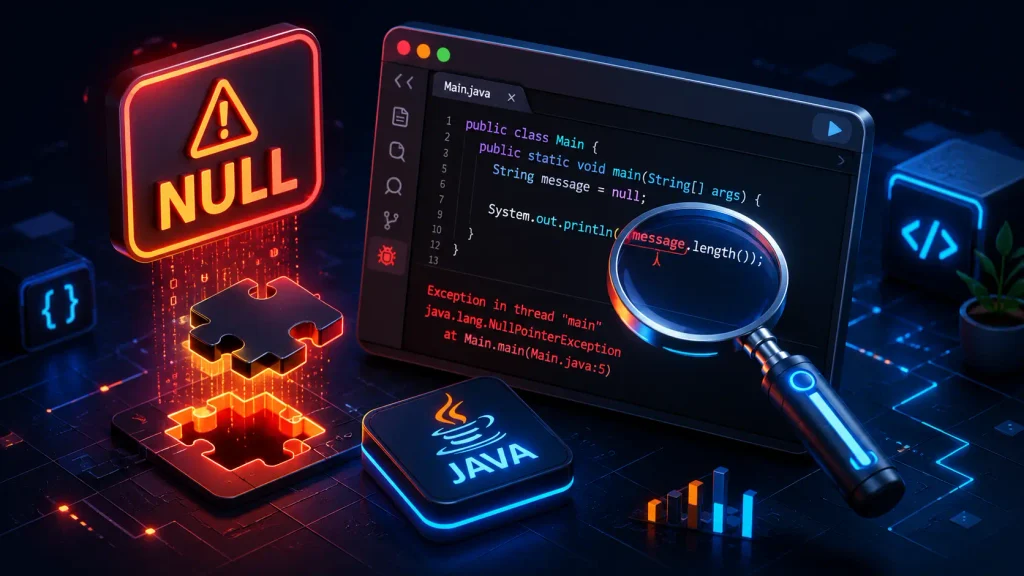
A NullPointerException (NPE) in Java is an unchecked runtime exception that occurs when an application attempts to use an object reference that points to null in memory. In Java, null signifies the absence of an instantiated object. When the Java Virtual Machine (JVM) tries to dereference null—such as invoking an instance method, accessing a field, or indexing through an uninitialized array—it halts execution and throws java.lang.NullPointerException.
Understanding and resolving NPEs is a core requirement for passing both beginner programming assessments and the AP Computer Science A (AP CSA) exam.
What Causes a NullPointerException in Java?
Every reference variable in Java holds a memory address pointing to an object created in the heap. If a variable is declared but never initialized with the new keyword or assigned an active reference, its default value is null.
An NPE triggers under four primary conditions:
- Calling an instance method on a reference pointing to
null(e.g.,str.length()). - Accessing or modifying a field/instance variable of a
nullobject. - Attempting to access array elements or methods on an array holding
nullreferences. - Autounboxing a wrapper class (e.g.,
Integer,Double) whose value isnullinto a primitive type (int,double).
+-------------------+             +-----------------------+
|  Reference (Stack)| ----------> |    Object (Heap)      |  ==> Safe Method Call
+-------------------+             +-----------------------+

+-------------------+
|  Reference (Stack)| ----------> null                        ==> Throws NullPointerException!
+-------------------+
Quick Comparison: Common NPE Triggers vs. Solutions
| Scenario | Buggy Code (Throws NPE) | Fixed Production Code |
|---|---|---|
| String Method Invocation | String s = null; s.length(); | if (s != null) { int len = s.length(); } |
| Literal String Comparison | userInput.equals("admin") | "admin".equals(userInput) |
| Object Array Traversal | Student[] list = new Student[5]; list[0].getName(); | list[0] = new Student("Alex"); list[0].getName(); |
| Wrapper Class Unboxing | Integer score = null; int finalScore = score; | int finalScore = (score != null) ? score : 0; |
Deep Dive: 4 Critical Scenarios and Code Fixes
1. Calling Instance Methods on Uninitialized Strings
The most common AP CSA scenario involves invoking methods such as .substring(), .indexOf(), or .length() on a variable that has not been initialized.
// CRASH EXAMPLE
public class StringBugDemo {
    public static void main(String[] args) {
        String studentName = null;
        // Runtime Crash: java.lang.NullPointerException
        System.out.println(studentName.toUpperCase());
    }
}The Solution: Guard Clauses
Always validate that the reference is non-null before executing member methods.
// PRODUCTION FIX
public class StringFixDemo {
    public static void main(String[] args) {
        String studentName = null;

        if (studentName != null) {
            System.out.println(studentName.toUpperCase());
        } else {
            System.out.println("Student name is unassigned.");
        }
    }
}2. The String Comparison Pitfall (.equals() vs. “Yoda Conditions”)
When comparing a variable against a known string literal, invoking .equals() from the variable will throw an NPE if the variable is null.
// CRASH EXAMPLE
String role = null;
if (role.equals("INSTRUCTOR")) { // Throws NullPointerException!
    System.out.println("Access granted.");
}The Solution: Constant-First Comparison
Invoke .equals() directly on the string literal. In Java, string literals are guaranteed non-null objects. Passing null as an argument to .equals() safely evaluates to false without crashing.
// PRODUCTION FIX
String role = null;
if ("INSTRUCTOR".equals(role)) { // Evaluates safely to false
    System.out.println("Access granted.");
}
3. Object Arrays vs. Primitive Arrays
Creating an array of primitives (such as int[]) automatically initializes every element to 0. However, declaring an array of reference objects (such as String[] or Book[]) initializes all slots to null.
// CRASH EXAMPLE
String[] names = new String[3]; // [null, null, null]

for (int i = 0; i < names.length; i++) {
    // Crashes on iteration i = 0
    System.out.println(names[i].length());
}The Solution: Explicit Instantiation and Loop Guards
Instantiate each element within the array or guard inside the loop body.
// PRODUCTION FIX
String[] names = new String[3];
names[0] = "Java";
names[1] = "Python";
// names[2] remains null

for (String name : names) {
    if (name != null) {
        System.out.println(name + " has length " + name.length());
    }
}4. Automatic Unboxing of Wrapper Classes
Java automatically converts wrapper classes (Integer, Double, Boolean) to primitives (int, double, boolean) via autoboxing and unboxing. If the wrapper object is null, attempting arithmetic or primitive assignment throws an NPE.
// CRASH EXAMPLE
Integer rawScore = null;
int finalScore = rawScore + 5; // Crashes: Calls rawScore.intValue() under the hoodThe Solution: Null-Coalescing Logic via Ternary Operator
Provide a fallback primitive default before unboxing.
// PRODUCTION FIX
Integer rawScore = null;
int finalScore = (rawScore != null ? rawScore : 0) + 5; // Evaluates safely to 5AP Computer Science A Exam Strategies
- FRQ Precondition Respect: College Board Free Response Questions (FRQs) frequently include preconditions stating
@param str is not nullor@param list is non-empty. When a precondition explicitly rules outnull, students do not need defensivenullchecks unless specified. - Array-of-Objects Trap: In Free Response Questions involving classes (such as designing inventory systems or student rosters), allocating
new Item[size]creates an array ofnullpointers. Ensure every index is explicitly assigned an object before invoking getter or setter methods. - Short-Circuit Evaluation: Leverage Java’s logical
&&(AND) operator to prevent NPEs in conditional statements. Because Java evaluates expressions left-to-right, placing the!= nullcheck first halts execution before the dereference occurs:
// Safe: if obj is null, obj.isValid() is never evaluated
if (obj != null && obj.isValid()) {
    // Logic here
}Frequently Asked Questions
Is NullPointerException a checked or unchecked exception?NullPointerException extends java.lang.RuntimeException, making it an unchecked exception. It does not need to be explicitly declared in a method’s throws clause or wrapped in a try-catch block.
What is the difference between null and an empty string “”?
An empty string "" is an instantiated String object residing in heap memory with a .length() of 0. In contrast, null indicates that the variable points to no allocated memory location. Calling .length() on "" returns 0, while calling it on null throws a NullPointerException.
Can a static method throw a NullPointerException?
Calling a static method via a null reference (e.g., Math m = null; m.abs(-5);) does not throw an NPE because static methods belong to the class rather than an object instance. However, if the static method itself contains internal dereferencing of a null object, an NPE will be thrown inside that method.
Conclusion: Debugging with Confidence
Mastering the NullPointerException is a rite of passage for every Java programmer. By understanding how to trace uninitialized memory references and applying defensive guard clauses, you will not only write more resilient code but also secure crucial points on your AP CSA exam.
Leave a Reply